
You never win easy
Last week I wrote about how programmes like Vision Zero

Last week I wrote about how programmes like Vision Zero only succeed if they are accompanied by a raft of measures to improve transport safety. They also need the support of politicians who understand the wider context and are able to articulate it. That last point is crucial: only those politicians who are confident about why they are trying to bring about change will succeed in bringing it about.
I chaired a meeting of my local Islington Cycling group this week where the speaker, Leo Murray, explained how change can be achieved. And, indeed, how difficult it is. His first message was that change will always be opposed. It is inevitable that there will be people out there prepared to argue against whatever is being suggested. Essentially people are reluctant to endorse change and indeed are often rather frightened by it. Therefore, campaigners have to be ready for the arguments that are going to be made against them.
There will, of course, be supporters for, say, a school street or a road closure to stop rat running. But they tend to be silent. In the middle there will be the vast majority who have no particular view. Leo argued that there is no point trying to win over those who are adamantly opposed. Their arguments are likely to be emotional rather than rational. Pointing to statistics rarely works. But you have to work on those in the middle, and crucially try to get some to go public with their support.
He gave the example of low traffic neighbourhoods, the schemes which aim to stop through running of traffic through neighbourhoods. There has been a strong campaign against these, often from people on the Left as well as the Right, on the basis that these discriminate against poorer people who are more likely to live on main roads. They are being made to suffer to allow people who live on leafy residential roads to enjoy a reduction in traffic. They even suggest that pushing more traffic on to main roads is racist as more black and brown people live on them than in the residential areas.
Leo mad two points. First, surveys show, he said, that ‘nine out of ten white people, nine out of ten black people and nine out of ten brown people live on residential roads’. There is absolutely no difference. Moreover, blocking off residential areas may generate extra traffic in the early days of implementing a scheme, but actually much of it disappears over time, a process known as ‘evaporation’. People find different routes to travel on or change mode or whatever.
However, when he pointed out these arguments to a friend of his who has created a campaign of ‘social justice’ to oppose low traffic neighbourhoods, the evidence was simply dismissed as not credible – even though it came from reputable academic sources. That’s a real problem. People do not listen to a truth they do not like – hello Mr Trump!
Therefore, any campaign has to brace itself against this type of opposition. Leo highlighted a concept known as the Goodwin Curve, named after its deviser Phil Goodwin, a long established transport professor. This is a U shaped graph that measures support for a scheme which tends to reach the bottom of the curve just before a scheme is implemented. That is when politicians have to hold their nerve because, as he pointed out, once schemes take effect, they are invariably popular. ‘No one ever wants to reverse a scheme once it is established’, he said.
Sadiq Khan, the mayor of London, understands this phenomenon, Leo said. Khan held firm over the introduction of the Ultra Low Emission Zone, despite a huge furore, and now no one thinks twice about it. As I run over Hampstead Heath and see the splendour of London, there is no longer a yellow miasma hanging over it which there was a few years ago. That is thanks to ULEZ and Khan’s courage in standing firm in the face of opposition.
Sadly not every politician has the courage to hold firm when people are shouting loudly at public meetings. Or writing endless letters to the local media. Many relent, withdraw schemes and forget about them.
One of the problems is consultation. This is not only vastly expensive, but also can lead to poor results with a majority against, even though they may actually benefit from the introduction of the scheme. It was clear that when ULEZ was expanded to outer London, many people campaigning against it did not realise that their cars would be exempt because their emissions were below the threshold. I was struck when visiting Paris to look at how they have managed to introduce very radical schemes in a short period to hear that while they did consult, it was a short process and was, crucially, only over the detail of plans, rather than their substance.
The reduction in traffic, encouragement of bikes, cutting parking spaces, closing roads around schools – all these policies fitted into a vision on which mayor Anne Hidalgo had campaigned. Therefore they were not open to discussion. Yes, details could be considered and amended, but people saying that they just wanted the same level of traffic, the same pollution emissions, were simply ignored. In Islington, where I live, there is no such overall vision which can obviate the need for lengthy consultation but in neighbouring Camden, their transport strategy explicitly states that the overall vision is to reduce traffic considerably by 2040. Schemes which do fit into that agenda, therefore, would be rejected.
His last point was equally interesting. Elections are very rarely won or lost on the issue of schemes implemented in the interests of traffic reduction. There is inevitably a lot of fuss about them from very angry people at the outset, but very few votes are lost – or indeed won – on these issues. People vote for all sorts of reasons, but transport rarely figures in their decision making process. That is both a shame, but also an opportunity for politicians to be radical.
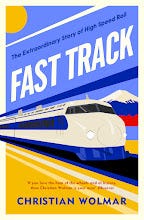
PS I have just finished writing my book on high speed rail, Fast Track, which will be published in July by Penguin. The cover is a great design. I have actually published four different editions of books this year. The paperback of the Liberation Line, a hardback and paperback revised version of Fire and Steam to mark the 200th anniversary of the opening of the Stockton and Darlington Railway, and a large Dorling Kindersley blockbuster version of a book I wrote a few years ago, updated with fabulous illustrations, called The Rise of the Railway. Do email me at Christian.Wolmar@gmail.com, if you want to buy a signed copy of any of these at a discount. The Rise of the Railway in particular makes a great Xmas present – and I can sell it at a discount, including postage, of just £27 rather than £35.
Please consider becoming a paid subscriber—your support makes this work possible. Premium members receive an audio version of each Monday article (narrated by me) plus an additional weekly article. To subscribe, click the orange button below or the orange box at the top of this post labeled “Upgrade to Paid.”
Join us — you won’t want to miss a thing! Questions ? Email wolmarsubstack@gmail.com
Excellent.
The backlash against ULEZ was completely avoidable. Ironically, for an organisation which used to excel at getting a message over eg London Transport, the roll out was cack handed and failed to keep even a courteous level of consultation, information and bringing on board.Therefore, a rag bag of anti's, all too often far right, able to capture the narrative.
It was classic Brownite, put people's backs up and was totally avoidable from City Hall. If you explained it helps kids breathe, stop dying in certain tragic cases, loads of you won't pay a penny and we have this fab idea called Super-loop, then it sold itself. But no, we know best, a fait accompli.
Its been a huge success and really improved air-quality as predicted...total cock-up messaging, avoidable and colossal own goal.