

Time for celebration. My new book, Fast Track, has finally arrived and though I say so myself, the cover is sensational and well done the Penguin designer for producing such a brilliant image. As for the contents of the book, it is up to you lot to judge.
It is a fab story, taking in the early attempts to speed up trains including the various races held at the end of the 19th century and the 1930s. But the bulk of the book is devoted to modern high speed rail, a story that started in Japan more than 60 years ago and one that continues to provide huge amount of media coverage. Indeed, high speed rail is rarely out of the news, whether it is the launch of a new magnificent railway, inevitably after a long gestation period and probably a budget overrun but by then who cares, or whether it is a debacle like HS2 or the California high speed rail project. There is even coverage of the fortunately very few accidents including the one in Spain this year that was the first high speed collision between two trains.
I devote a chapter to the struggles in the UK and US on their high speed lines but much of the book focusses positive, the amazing achievements of the various countries who have joined the high speed club, ranging from the earliest lines in Japan and France, to the biggest success stories, Spain and China.
On the way there are diversions to South Korea and Taiwan, Turkey and Saudi Arabia and lots of other places too. It was a fun story to write and research, which included trips to Japan and China, and there is no shortage of stories, such as the salamander who almost stopped a line being built and the jailing of the man who did the most to get China’ amazing network started.
My book launch party will be Thurs 30th July in London and I have signed copies of Fast Track available for £22 plus £4 postage. (The retail price will be £30.) Email me at christian.wolmar@gmail.com for a discounted signed copy.
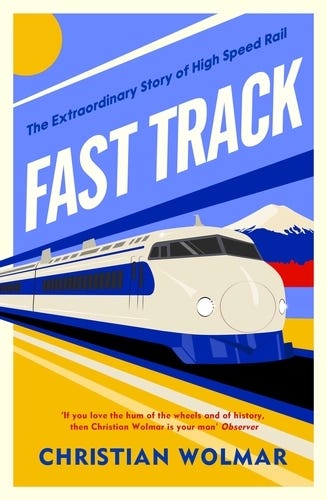
When i looked at the cover image - following your praise of it - were the colours of the mountain on the right (Fuji?) - white over blue over red (those of the Russian flag) over a lighter blue over yellow (of Ukraine) - not those of conventional Mt Fuji images. So wondering why they were chosen, and what If any was the symbology behind them.