
Simple solutions to big problems
There used to be a Zipcar and a van parked at the end of our road but suddenly they disappeared at the end of the year.

There used to be a Zipcar and a van parked at the end of our road but suddenly they disappeared at the end of the year. Zipcar was a useful service designed to help people cope without owning a car, by providing vehicles that could be rented by the hour without having to go to a rental car hire office. You simply used their app to get into the car and pay the fee.
Zipcar had been operating for several years in London but had been taken over by Avis who simply decided it was too much hassle and withdrew the service with very little notice. It is true that the economics are difficult as the price has to be set below a conventional car hire service and quite possibly it needed some support from the local authority to continue operating. Or at least free parking and an exemption from the congestion charge. Nevertheless, it was surprising that this service which had become a part of London’s transport system – and operated in several other cities - was suddenly withdrawn with little discussion and could not be made viable despite having 600,000 members. Its key selling point was that it obviated the need for personal ownership of vehicles.
I was remined of this by an excellent article in Passenger Transport magazine by a long time transport campaigner Jonathan Bray which focussed on three transport policies which, as he put it, have been stuck in the ‘crawler lane’. On shared use car services like Zipcar, Bray points out that our neighbours across the Channel, France, have developed a thriving series of carpool businesses thanks to the government encouraging their development. There are 900,000 users in Paris alone who carpool every day to work and on some routes app-based sharing services provide a fixed stop service. It is a kind of revival of the hitchhiking which allowed me to see much of Europe as a young man but which sadly became unfashionable out of fear of strangers – this will be the subject of a future Substack.
Bray’s other two forgotten policies are equally relevant and have the potential to help the move towards sustainable transport. He laments the lack of a coherent policy on coaches which rightly he sees as a neglected mode of transport. While in Northern Ireland and Wales, the state is trying to use coach policy as a way of linking towns and cities that are not connected by rail, in England coach services are provided privately by companies that concentrate on obviously profitable routes but leave whole swathes of the country without scant or no provision. I remember trying to get between Derby and Leeds on a day when floods have prevented train services from operating, and there was only one coach available for that journey all afternoon and I was very fortunate to get one of the last tickets, with dozens of people turned away. Yet, it was a 75 mile journey mostly along a motorway which was quicker than the train as there was no direct service between the two cities.
But there is no government policy to make use of coach services to fill gaps in the train service or boost transport to remote areas, which would help those without access to a car. Nor is there ever any discussion in transport circles about this gap.
The third policy Bray highlights – or lack of it – is parking. Taking parking spaces away has become almost routine in European towns and cities, big and small, as removing them encourages people to use other modes. There are numerous barriers to clamping down on parking, not least the fact that it is lucrative for local authorities and that people often protest against the removal of spaces. However, if it is part of an overall strategy towards sustainable transport, their objections can be ignored.
Rather than implementing these low tech solutions to transport problems, the Department for Transport is trying to kowtow to the tech bros by encouraging ridiculous innovations such as driverless cars and even, possibly, deliveries by drone. Bray is right that these are neglected areas which could make a big difference. Possibly ministers could take him on as an adviser….
Please consider becoming a paid subscriber—your support makes this work possible. Premium members recieve an additional weekly article. To subscribe, click the orange button below or the orange box at the top of this post labeled “Upgrade to Paid.”
Join us — you won’t want to miss a thing! Questions ? Email wolmarsubstack@gmail.com
Also consider joining me : The South Eastern Railway – A journey through the past, present and future Wednesday 11th March 6:45 PM at One Birdcage Walk London. Join us for a special event to celebrate the proud history of the railway in London and the south east. Buy tickets here https://tinyurl.com/24d2ch4f
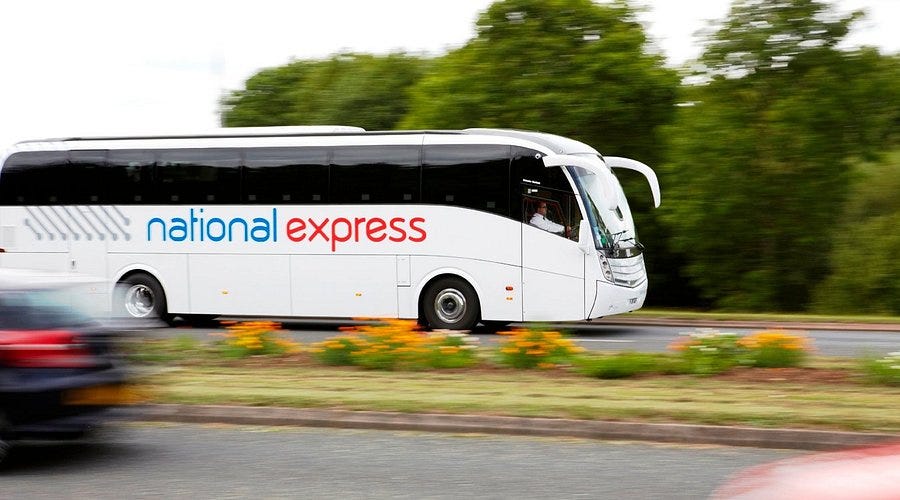
"But there is no government policy to make use of coach services to fill gaps in the train service or boost transport to remote areas, which would help those without access to a car."
If a coach doesn't add up, isn't profitable, what's the utilisation of that, and is it more or less cost or energy efficient than a taxi? I make use of rural buses sometimes and the morning buses have high demand from children going to school, people going to work. The rest of the day, they're about empty.
And at what point do we say, maybe people living in a hamlet in rural Somerset have made a choice and can pay the costs of it, and can sort out their lives? If you want to have public transport move to a town of 10,000 people like Wells, Shepton Mallet or Glastonbury that can support it. Or pay for your own taxis.
Before the 1985 Transport Act deregulated bus services, the 1980 Transport Act had deregulated coach services.