Accidents don’t happen in a vacuum. The history of railway safety has consistently featured changes resulting from disasters. Yet, because warnings were ignored and lessons not learnt, it took nearly two centuries to achieve a railway that could really boast about its safety record. However, the penny finally dropped and we have, fortunately, in recent years, gone from a railway in which there were routinely multiple fatality accidents every year to one where several years pass between such disasters.
Modern technology and better training have contributed to this improvement, but there is no guarantee that this trend will continue. Indeed, Office of Road and Rail figures show some worrying trends, such as a 50 per cent increase in signals passed at danger in the past year. Yes, there are more red signals on the crowded network, that does not explain such a steep rise.
I have been contacted by senior sources in the industry who are concerned that this may be indicative of a more profound trend. The excellent recent safety record, which has seen such an improvement in the twenty first century compared with previous one, has been taken for granted. The attitude seems to be that safety is a done deal and therefore managers can focus on other aspects of the railways.
This is not, of course, universally true. I am struck by how often some managers mention safety, but it is a fact that safety has not been the subject of major speeches by rail industry leaders or indeed their political counterparts that is of concern. The right kind of culture on safety has to come from the top so that it becomes inculcated in the workforce.
Whenever I get a cab ride, I am indeed shocked by the amount of junk there is on the railway, and how this is an illustration that safety is not taken seriously. Old bits of rail and rotting wagons along with other metallic junk litter the network along with buddleia and other weeds. Graffiti is no longer routinely wiped off, giving a poor impression of the railways.
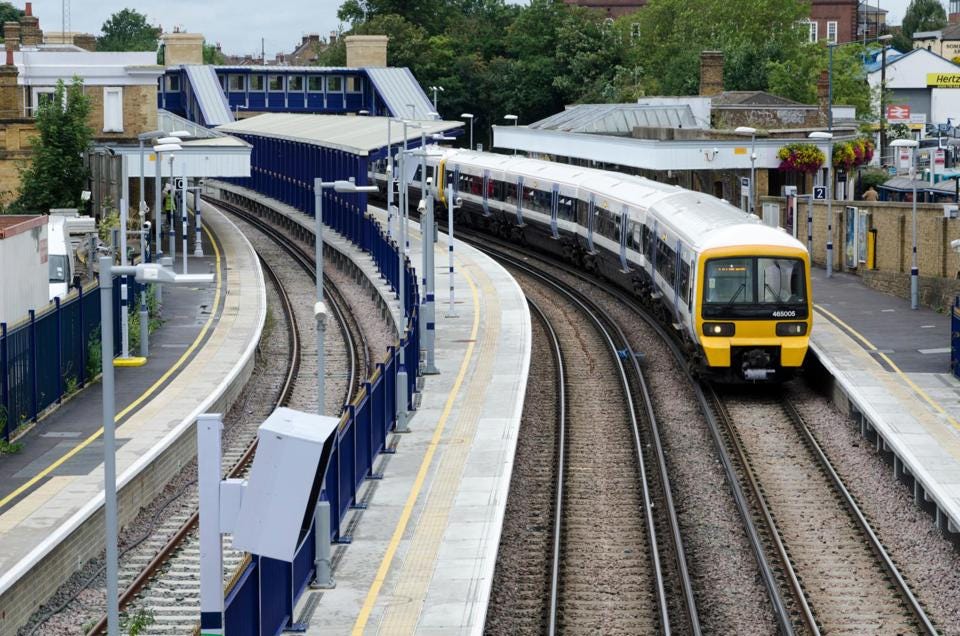
The Bedford accident should result in a more checks, more thinking about potential issues and even some action, which may cost money. The industry is only ever a heartbeat away from a disaster. I am still haunted by how just a fortunate Britain’s worst rail disaster in peacetime was averted by la few seconds. It is now more than 11 years since the Wooton Bassett near miss when a charter train went through two signals and fouled the main line where a high speed train had passed less than a minute earlier. The idea of a high speed train slamming into a charter hauled by a steam engine with a total of nearly 750 aboard the two trains still sends shivers down my spine every time I think about it. And indeed what makes me even angrier is that the driver of the charter was only given an eight months suspended sentence for his idiocy and the charter company, West Coast is still in business when it should have had its licence withdrawn permanently. The fine of £200,000 it received was derisory.
We now know that the signal passed at danger by the train in the Bedford crash was not fitted with the Train Protection and Warning System which has been so effective in reducing the number of SPADs. This is a financial decision as fitting the system is expensive and rightly there are budget constraints. The argument is that this is a section of plain line while TPWS is limited to complicated junctions and the throats of larger stations. However, one manager I spoke with says this was long known as a slightly worrying section of track because it soon turns into a curve.
There is, too, a major source of new risk which has not received sufficient attention. While traditional accidents caused by SPADs, overspeeding – the subject of a recent RAIB report involving a incident at Grantham – and derailments – such as the recent incident in Cumbria on the West Coast – provide the mainstay of the organisation’s investigations, the complete stoppage of all trains in Germany for more than two hours on June 23 demonstrates starkly the new source of risk - the ever greater reliance of the railways on software systems that may well be out of date. The stoppage, according to Deutsche Bahn, was the result of a fault introduced into the GSM-R radio system which provides what the industry calls ‘ship to shore’ communication. Apparently, the software behind this ancient system which is now half a century old triggered the breakdown and consequently the stoppage of all trains as it is not considered safe to run services without the ability to contact control centres.
Actually, being a cynical old bastard, I am less than convinced by this story but I have been unable to discover whether there is a more sinister explanation relating to cyber attacks or fundamental faults in the system.
I have long been worried about the potential risk of a total breakdown in the UK system caused by a software issue. This has become more likely because of the concentration of facilities in a small number of locations. Both signalling and power provision are now largely centralised, which makes the system more vulnerable to an attack or a failure. Cyber attacks, along with climate change, are the two most likely source of industry failures and while lots of publicity has been given to the later, the risks from software issues have attracted insufficient attention. There are legacy systems on trains that like the German radio network stretch back into the 1970s and while efforts are made to eliminate the risk from them, nobody quite knows what systems are in operation and where they are located.
The creation of Great British Railways will both help this situation by ensuring there is more information on industry assets, but by bringing together many disparate systems, it also presents a new risk. I see no sign yet of any coherent work on this potential area of risk to the industry, but clearly whoever takes over at GBR needs to examine this urgently.
What happened to the trams?
Most conspiracy theories are works of fiction best confined to Dan Brown novels but just occasionally they ring true. In the comedy film Who Framed Roger Rabbit, there is an odd subplot about how the tram system in Los Angeles was closed down on the instigation of motoring interests. In fact, that explanation is still the subject of debate but there is no doubt that there was fierce opposition to the street car system, as it is called over there, from vested interests in the motoring industry.
What I had not realised, is that there was a similar – and indeed successful plot – in the UK against trams. Indeed, according to Mick Hamer in his excellent book The Great tramways Conspiracy, there were really two separate conspiracies. The first early in the twentieth century, largely failed. It was an attempt to prevent systems being built and, in particular, from being municipally, rather than privately, controlled. It was organised by various right wing newspapers and the major private tram company, BET, abetted at times by railways eager to see off competition from trams, which wanted to make profit out of the tram systems rather than allowing local councils to run them. By and large, the public systems offered a better service and were able to prevent the private company from taking over their systems. The first couple of decades of the 20th century were therefore the heyday of the tram systems which provided cheap transport for millions of workers. But it was being constantly undermined by opponents in particular, the growing power of the motoring lobby, which used underhand tactics such as fake letter writing campaigns to local newspapers, which were produced centrally rather than by local people, and painted trams as an old fashioned and redundant system. By dominating the membership of a Royal Commission on transport, the anti-tram lobby managed to persuade the authors of the subsequent report to advocate the abolition of all tram systems as ‘they got in the way of cars’. Effectively with the exception of Blackpool this disreputable campaign achieved its aim by the early 1960s, whereas other countries in Europe retained their systems and were consequently able to renew and expand them when the fashion changed. Interestingly, France, thanks to a similar campaign, also scrapped all its trams but thanks to more enlightened transport policies, now has systems in 25 towns and cities across the nation.
The scrapping of trams was the greatest transport policy error of the 20th century – with Beeching cuts being on a par - and as Hamer painstakingly points out, was brought about by a nefarious campaign carried out by vested interests. Reading the book is essential for anyone interested in the history of transport in the UK. You can hear an interview with Mick Hamer on my podcast, Calling all Stations.
YOU ARE INVITED TO THE LAUNCH OF FAST TRACK CHRISTIAN WOLMAR’S NEW BOOK ON HIGH SPEED RAIL
Join us to celebrate the launch of Christian Wolmar’s new book on high-speed rail.
The launch event is on Thurs 30th July 6.30–8.30 Lodon. Christian will be in conversation with Andrew Martin, author of The Moquette Mystery and To the Sea by Train.
Places are very limited. (ONLY a few spots left ) If you’d like to attend, please email wolmarsubstack@gmail.com
Can’t make the event? Signed copies of Fast Track are also available for £22 plus £4 postage. (The retail price will be £30.)
To reserve a signed copy or request an invitation to the London launch party, please contact us at wolmarsubstack@gmail.com