
Learning from the Dutch
It’s coming up to crunch time for Great British Railways.

It’s coming up to crunch time for Great British Railways. The Bill to create the organisation is re-entering Parliament this week and we will begin to get a stronger idea of how it will work.
Already there are signs that the Government understands that improving therailway service is essential if the renationalisation is to be a success. Last week, the Department for Transport set out plans to greatly improved internet coverage on the trains, both capacity and range to ensure that people can not only send emails and social media posts, but also download films and have uninterrupted Zoom calls. I have long argued that good internet coverage is as necessary to rail travel as toilets and access to catering facilities. It is not an optional extra but an essential part of modern travel.
This is a good start but much more is needed. Indeed, I like the idea being promoted by the ‘We Own it’ campaign to emphasise the public purpose of the railway. The previous privatised model supported the notion of on rail competition which actually led to a sub optimal timetable geared towards helping private sector companies which received hidden subsidies.
The idea that railways are a public service must be at the heart of the new organisation. I have just returned from the Netherlands where the railways are nationalised and are very much seen as part of a transport system that place great emphasis on sustainability and public welfare. Hence, there are massive free cycle parking spaces such as the one I visited in Utrecht which had room for 12,000 bikes. Even a town like Delft, with a population of just 110,000 has a remarkable 10,000 cycle parking spaces for rail passengers.
As mentioned in a linkedIn post by Jonathan Bray, formerly head of the Urban Transport Group, Dutch stations are classified according to size and have facilities according to the level of throughput. In other words, passengers know what to expect. It would be a positive mood for Great British Railways to do something similar, so eople would know if they could buy tickets at stations or indeed use the toilet.
The big unknown is what to do about fares. In the Netherlands, people can make any journey simply flashing their bank card at the entry gates, as happens on the London Underground. While Britain’s system is far larger, surely we could be working towards that, at least for heavily used stations.
The fares level is another conundrum. I have argued there ought to be a set fare between any two stations and then less used trains could be say 30 per ent cheaper, and more expensive ones 30 er cent nre expensive. It would be both a simplification and a way to guarantee maximum revenue. But so far there has been total slence n fares, something which needs to change.
Most important, the creation of GBR is a opportunity for the government to show it is both competent and innovative. It has got to be made to work.
Please consider becoming a premium member and support my work. Thank you !
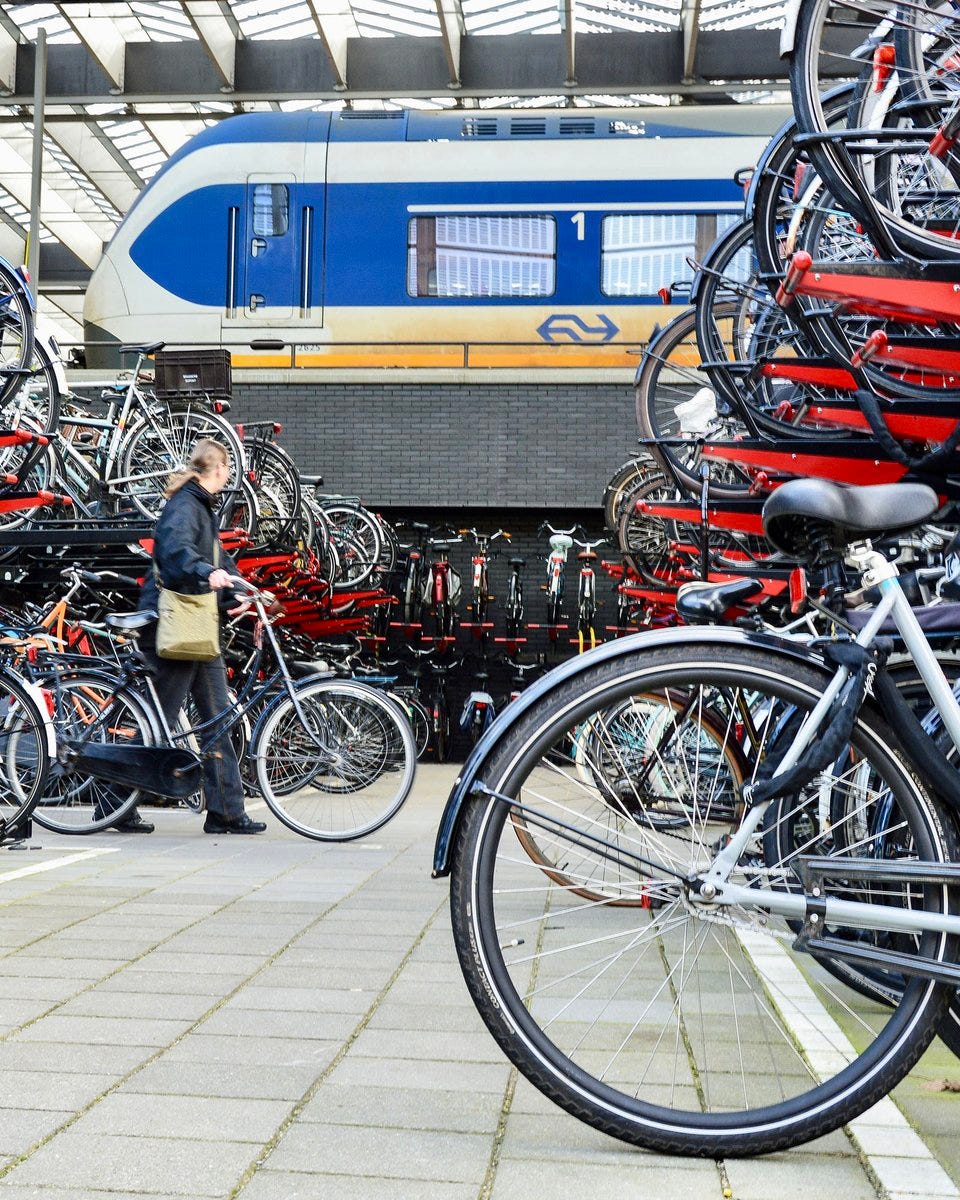
The cycle parks near Amsterdam Central Station hold thousands of bikes. Simplification of fares is essential and also permanent reductions for families, It is ALWAYS cheaper to take the car with children and that needs to change