In researching my new book, Fast Track, which has now reached the bookshops, I came across numerous stories of how some projects were completed while others fell by the wayside. Delays between conception and completion on numerous occasions spanned decades, with Turkey bizarrely having the longest period as the idea for a high speed line was developed during world war two and the first part of the line did not open until 2009. Makes the UK look speedy.
Turkey is, too, the site of the longest redundant tunnel, a ten kilometre effort that could not be used as it was built to the wrong gauge and remains, to this day, unused. There are several other examples of sections of line that have never been used or needed to be bypassed, but the most remarkable failures were on projects based on alternatives to conventional rail.
It is little known that the development of high speed rail could have been stymied and the very concept might have been abandoned in favour of alternatives, notably some variant of maglev. Indeed Japan’s scheme, built 17 years before France built its first line, might have been not just the world’s first, but a unique project without parallel elsewhere.
I discovered a pattern with a similar process unfolding across several countries. The first of these attempts to use an alternative to conventional steel wheel on steel rail was, surprisingly perhaps given its pioneer status, in France. Thanks to a canny entrepreneur called Jean Bertin, the French TGV very nearly did not happen. As in the UK, France had seen a brutal paring back of the rail system and no new lines had opened since 1928. Beeching was running rife in the UK at the time and everywhere in the world the railways seem to be in retreat while motorway and aeroplanes were starting to become the norm for medium and long distance travel.. Perhaps trains had had their day.
Bertin a canny and pioneering engineer proposed an alternative, a magnetic levitation system whose modernity seemed more in tune with the age of Sputnik and fanciful ideas promoted in comics and magazines such as flying cars and jet-propelled back packs that would make even walking redundant. I quote Arthur C Clarke, the great British scifi author who wrote the script for 2001, A Space Odyssey saying: ‘the history of the railways, which have given great service to humanity for a century and a half is now entering its final chapter’.
The best description of Bertin’s invention was ‘hovertrain’, which used nascent hovercraft technology to raise itself and then, initially, railway technology, and later rockets, to propel itself forward. After building a short test track with a small scale model, in 1966 Bertin, with the help of government funding ironically much of which went through SNCF, the French state owned railway, unveiled a 7km long elevated test track rather cheekily built on part of an abandoned railway line between Paris and Chartres. Within days of the launch, the sleek coaches were thundering along at 345 kph encouraging him to build a second set of coaches which reached a speed of 422 kph in January 1969.
Bertin was on a roll. His Aérotrain would be the land equivalent of Concorde, which was in development at the time. Ideas for new lines were popping up everywhere as visitors flocked to the site of the test track. The Common Market, as it was then called, proposed a line linking Luxembourg with Brussels. A new longer test track was built near Orléans and the French government agreed to fund a line linking the two main Paris airports with the centre of the city.
But then the whole scheme fell apart. The track proved more expensive to build and land for it was difficult to find. Putting a rocket on the back of the trains certainly gave them the required speed but made noise that was, euh, like a rocket. There were technical issues to and the lack of connection with the existing rail network would prove inconvenient. President Pompidou died and was replaced by the less enthusiastic Giscard d’Estaing who pulled the plug and gave, instead the go ahead to the Paris Lyon TGV line. All that is left of Bertin’s dream are a few rotting concrete pillars, a fate that HS2 has only narrowly escaped. But maglev did not go away and Germany went through the same debate over whether it was a better technology than conventional rail.
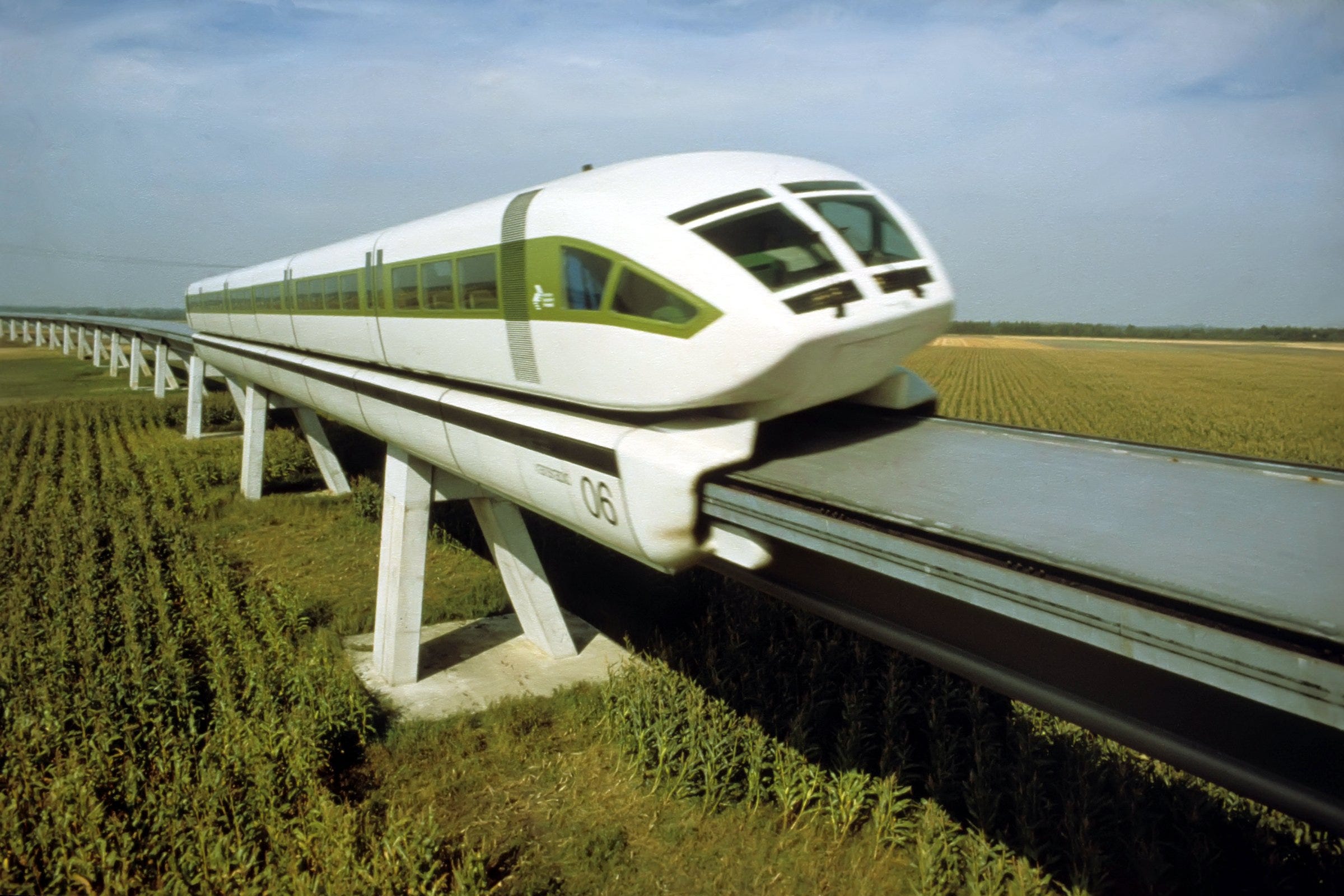
In the early 1970s, the German government began to take an interest in the technology and was initially so enthusiastic about the idea that it committed some £500m to support the construction of a test track and prototype vehicles. The scheme for a 300 km line between Hamburg and Berlin was included in the government’s transportation plan with a start date of 1994 for completion in 2005. The two cities would be linked in just 55mins with the Transrapid, as it was called, running at 450 kph.
But then, just as in France, reality set in. Building new stations in city centres and tracks in the suburbs was proving too difficult and consequently stations would have to be on the outskirts, necessitating a change of mode. Meanwhile, Deutsche Bahn had embarked on its ICE – InterCity Express – scheme to link the nation’s major towns with a 2,500 mile network. With opposition to Transrapid mounting, the government decided to go for its mix of high speed lines interspersed with upgrades of existing routes that characterise ICE and abandoned maglev development, Its fate was sealed by a disaster on its test track in September 2006 which highlighted the risks of running relatively light vehicles – a requirement given they have to be levitated – at high speeds. A maintenance vehicle had been left on the tracks and a test train smashed into it killing 23 of the scientists and other project staff on board. Ironically, though the technology was sold to China and used on its maglev service between Shanghai suburbs and the airport.
Now big maglev schemes are being developed in both Japan – where the scheme has all the hallmarks and cost overruns of HS2 – and China but I suspect it will only ever be a niche market. Elon Musk’s idea of running maglev in a tube and calling it hyperloop was a nonsense, with the capital costs being far too high to ever sustain a service that would have been run by 30 seater trains at best. He actually only promoted it to damage the California high speed rail project which sadly has needed no external threat to turn into a white elephant. Ironically, the first maglev system in operation in the world was a shuttle within Birmingham airport, that ran from 1984 to 1995 at a modest 22 mph.
High speed rail has enabled the railways not just to survive in the 21st century, but to thrive, giving an old technology a new lease of life. That, in these grim times and in the face of the ever mounting problems of HS2, is worth celebrating.
Heathrow no longer needs its express
It is time to say goodbye to the Heathrow Express. It is a ridiculously expensive way to get between the airport and Paddington, and only thrives because of ignorance. Tourists arriving often sleepy as a result of long haul flights are not in a state to assess the various prices and usefulness of the three different train services on offer at the airport – Heathrow Express, Elizabeth Line and the Tube.
The very name Heathrow Express gives the premium rail service and advantage and as there is no clear signage in the airport setting out what might be the best and most economic way to get into the centre. Of course the Elizabeth line is slower and the Piccadilly even more so, but often it might be more convenient as well as cheaper to take these alternatives given that Paddington is not the most accessible station.
Heathrow Express’s contract with Great Western Railway runs out in June 2028 soon after the establishment of Great British Railways, and that would be an opportune moment to kiss it goodbye. Certainly a new contract would be a big mistake since its train paths and two platforms at Paddington would be much better put to use to serve the Southern access route that has long been mooted but stymied by government inaction. Most of the money would come from the private sector and would make Heathrow into a through station, for which passive provision has been provided.
Discount signed Fast Track books available- you can get signed discounted copies from me by emailing christian.wolmar@gmail.com