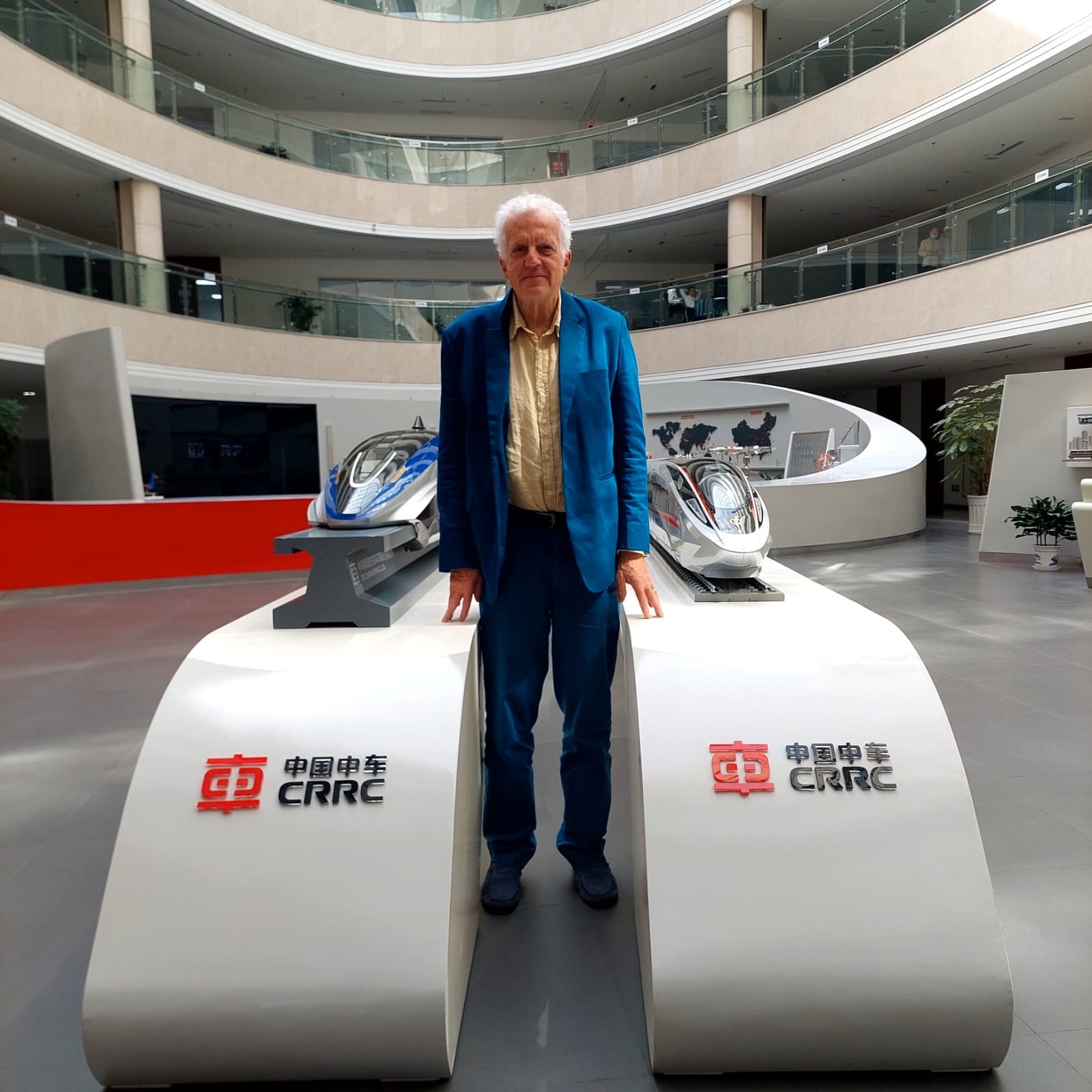
Nothing can quite prepare you for the shock of China. I knew the numbers before I arrived, but as I toured the country’s high-speed railways and visited towns and cities with motorway systems that make Birmingham’s Spaghetti Junction look like a village crossroads, the sheer scale never ceased to amaze me.
China has 48,000kms of high-speed train lines, about 70 per cent of the global total, with plans for many more. There are up to 10,000 daily services in operation, using 4,380 eight-coach trains – almost two-thirds of the world’s 250kmph-plus rolling stock – and welcoming about 10 million people on average every day.
The country’s development of high-speed rail has been rapid even by Chinese standards. The first line opened in 2008, which means that more than 7km of track a day have been completed since then. To put that in perspective, in less than two decades, China has built a system three times the size of Britain’s entire rail network, which was constructed painstakingly over the course of 70 years in the 19th century. It is tempting, if cruel, to remind British readers that work on the 225km HS2 line between London and Birmingham started in 2019 and may (or may not) be completed by 2036 or 2039.
I spent a week touring the Chinese high-speed system XXXXX, as research for my new book, visiting two of the three main factories and talking to a wide range of officials and managers. Access was relatively open, though precise questions were often answered vaguely and there were clearly no-go areas.
China’s rail network is an integral part of its strategy to develop into a technological powerhouse. This being the People’s Republic, the economics are opaque. The rail operating company, the rolling stock manufacturers and the builders of the lines are all state-owned enterprises. The latest accounts show a small profit but the amount of subsidy, hidden through transfer pricing, is difficult to establish. Precise sums are hard to come by but the official cost of building the railway is estimated to be between 100m and 200m Chinese yuan per kilometre (£11m to £22m) – meaning the overall cost is about 10,000 billion yuan, or £1,000 billion.
Still, it is clear that today China leads the world, by some distance, in building high-speed lines cheaply and running them economically. And with 25 countries already using high speed rail, and others seeking to join them, the companies behind the Chinese system are in a position to dominate other markets as well as their own.
China came late to the idea of railways, only opening the first line in 1876, and tearing this up the following year because of a dispute between the Qing government and the British trading firm that oversaw construction. By 1895, a mere 18 miles had been built, by which time most European countries had almost completed networks covering tens of thousands of miles.
Even after a national system was created in the early and mid 20th century, it was thinly spread and was not an integral part of the nation’s infrastructure. As for high-speed railways, the Chinese started building them four decades after Japan, which opened its first dedicated line in 1964, and a quarter-century after the French.
The early lines were built with the aid of foreign technology after contracts were signed with four of the world’s leading train manufacturers – Bombardier and Alstom (which have subsequently merged), Siemens and Kawasaki – in the early 2000s. The pioneering minister for railways, Liu Zhijun, had realised that China needed the knowledge from these companies to be able to catch up and maximised the amount of technology transfer, in line with the Chinese government’s policy, which required foreign investors to share their knowhow with local firms. The main beneficiaries were the two Chinese state-owned enterprises that subsequently merged to become the China Railway Rolling Stock Corporation (CRRC).
The factories that build the trains are on a scale to match the high-speed network. The first thing that strikes visitors to the huge complex at Changchun in northern China is the silence. There are no oil stains or dirty rags on the pristine concrete floor and in the factory, where the wheelsets are produced, every worker is permanently tagged so that the managers know precisely where they are and what they are doing.
Changchun is the biggest of the three principal factories of the CRRC, employing 20,000 people at this site to produce not just high-speed trains but a range of different types of rolling stock for underground and tram lines to suburban and regional train services.
The approach is extremely methodical. Several key aims are prioritised, such as reducing the weight of the trains through the use of different materials, reducing the amount of energy required and limiting the amount of noise and vibration.
Travelling on the trains was a revelation. The high speed network is totally separate, with a different signalling system which prevents any running on the conventional tracks. As if to emphasise this, large sections of the high-speed line are on concrete arched stilts a dozen feet above the ground. Elevating the line is initially more expensive, but maintenance is cheaper in the future as the track will deteriorate less than when laid on the uneven ground.
The current set of trains can run at 350kmph but are generally confined to 300kmph as a cruising speed. This is similar to the French TGVs and the Eurostar, which run at about 300-320kmph. CRRC is now working on a 400kmph version, which it is hoped will be introduced next year. The fastest domestic train in the UK, the Southeastern Javelin, runs at about 225kmph.
There is no random hopping on a train in China. Security is tight with luggage screened before you enter the station. All seats are pre-booked online and there are no tickets, just receipts.
I was told that people who have run up debts or who have misbehaved on a previous journey are banned, as presumably are those the state might want to prevent from travelling.
Passengers are not allowed down to the high-speed platforms until about 20 minutes before departure time and they pass through automatic gates using their ID cards as identification. Foreigners have to use their passports and pass through a gate where the documents are checked manually.
My first high-speed rail journey was between Beijing and Qingdao, home of the famous Tsingtao brewery, a distance of almost 700km. I travelled business class for a whopping £125, compared to £35 for standard class. First class was £61 but only offered slightly wider seats, whereas in business class you have an enormous amount of space, enough to extend your seat as if you were in a luxury cinema. It was like flying first class and the service was very attentive, though the meal was pretty unexciting – a pre-packaged and reheated stew of ribs and vegetables, with a pot-noodle type soup as an accompaniment.
Each of the several journeys I took, which all lasted several hours, went without a hitch, with trains on time and very little fuss. There was never a jolt or any vibration.
China plans to have 70,000km of high-speed rail by 2035, which may be optimistic given that it represents an increase on an already breathtaking pace, but there is little doubt, barring either an economic or technical catastrophe, that this will eventually be achieved.
It is easy to argue that this has only been possible because China is an authoritarian regime. Of course, the power of the state, able to marshal resources, grab whatever land it needs and direct funds towards a policy it has prioritised has no parallel in western democracies except in wartime. However, that does not mean there are no lessons to be learned. The ability of the Chinese to plan such a project, to manage it across the board, to develop the supply chains, to harness the skills of the workforce and to provide the finance does offer an example to follow.
But a coherent response is vital. In 2019, the European Commission rejected a merger between Siemens and Alstom, Europe’s two largest train manufacturing companies, specifically because it was worried about competition in the high-speed train market. The proposed merger had been a direct response to the fear of being outgunned by the Chinese, and an attempt to create a company that could compete. Perhaps a rethink is needed.
Fast Track:The Extraordinary Story of High Speed Rail by Christian Wolmar (Penguin Michael Joseph) is out on 23rd July Signed copies of Fast Track are also available for £22 plus £4 postage. (The retail price will be £30.) email me for copy christian.wolmar@gmail.com