The race to develop the world’s fastest train has been more tortoise than hare. The process has taken decades, and China and Japan have spent billions on technology they hope will outpace any conventional railway, and possibly even jet aircraft.
Both nations have produced test vehicles that exceed 370mph and have plans to open lines to the public. Last month a Chinese company announced that, in a remarkable trial run on a test track in Hubei province, a one-tonne flat carriage accelerated to almost 500mph in 5.3 seconds, a new speed record.
The key to such astonishing speeds is magnetic levitation, or “maglev”. It is by no means a new technology: the concept was devised more than a century ago. Initial patents were filed before the First World War. The basic idea is to use the fact that magnetic opposites repel each other and therefore the train can be kept in the air while it is propelled in various ways, such as by electromagnetic forces, conventional engines or even, in one case, rockets.
However, despite decades of trials in several countries, the technology has proved difficult to adapt to create a fast and efficient system.
Japan is the obvious test bed for maglev, having invented the bullet train in 1964. The country’s ambitions are centred around capacity and reducing journey time on one of the world’s most crowded long-distance rail routes, Tokyo to Osaka. The Linear Chuo Shinkansen train will connect the cities, covering 270 miles in 67 minutes. (Trains from London to Carlisle take three times as long to cover roughly the same distance.)
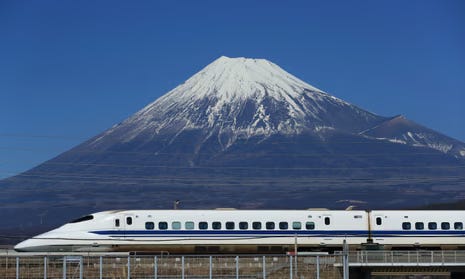
Trains speeding past Mount Fuji have become a talismanic image of the nation, but Japan’s ambitious maglev plans were held up for more than a decade by a politician who did not want the line passing through his fiefdom. It was only after the governor of Shizuoka province, Heita Kawakatsu, resigned in 2024 that his successor agreed that the project could go ahead. In July, the governor and rail operator JR Central agreed the train could pass through the prefecture (which should, at the predicted speeds, take seconds). Work is progressing on the first section, between Tokyo and Nagoya.
The difficulty of introducing maglev has not just been the high cost of construction but also its energy consumption and sheer complexity. It requires the train to be levitated 10cm above the track, which makes the system very resilient in coping with track defects but requires huge amounts of energy. Retractable rubber wheels are used when the train is at rest because it cannot “float” while stationary, another design complication.
The Chinese have been developing a different technology, based on magnetic attraction rather than repulsion. This requires lower levitation — the train is raised by an electromagnetic force that lifts it a few millimetres above the track. But it is still energy intensive.
China already has a maglev service between Shanghai and its suburbs, which has been running since 2004 with mixed results. The train used to operate at 268mph but this has been cut to 186mph to save energy, only lengthening the 19-mile trip by less than a minute. But high ticket prices have deterred many users.
The original Shanghai maglev system was based on German technology, but now China is developing a new system with the ambition of reaching 600km/h (373mph). It seems ready to pay the huge amounts necessary to build a big maglev line, and the 750-mile journey between Shanghai and Beijing is the obvious route. Even though the cost would be astronomical, this is a country that has built almost 30,000 miles of high-speed line since 2008.
As for the UK, there is only history. In 1984, Birmingham airport opened a maglev shuttle service running 600m to the international railway station. The top speed was 26mph. It closed in 1995 due to unreliability and lack of spare parts.
Fast Track: the Extraordinary Story of High-Speed Rail by Christian Wolmar (Penguin, £30). To order a copy go to timesbookshop.co.uk. Free UK standard P&P on orders over £25. Special discount available for Times+ members.
You can order signed books at a special discounted price or a poster. Email me christian.wolmar@gmail.com
Thank you for supporting my work with a premium subscription. Your support helps make it possible for me to continue this work.